
Early-Stage Hiring Has a Queue Problem. AI Interviews Shorten It.
Picture a recruiter with eleven open roles and forty candidates to screen before Friday. This week is illustrative and describes no customer.
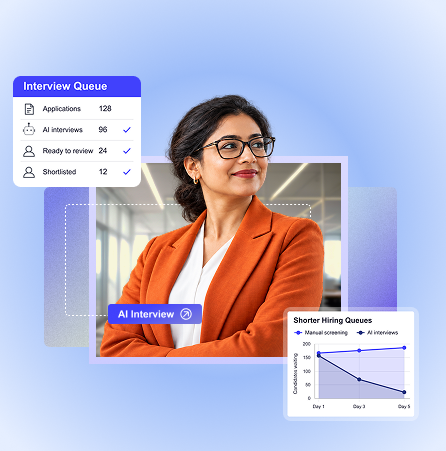
AI interviews speed up early-stage hiring by taking scheduling out of first-round screening. Each candidate answers the same role-specific questions on their own time. The recruiter then reviews the scored answers. Side by side, they decide who moves forward. This article shows where recruiter time goes today, how Vriti.ai approaches the problem, and how to judge any AI interview platform.
Read This Before Your Next Screening Call
•The line. One call at a time means your strongest candidate waits as long as everyone else.
•The shift. With Vriti AI Interview, candidates answer on their own time, and you review scored answers side by side.
•The check. Count the days from application to the first completed screen. If a strong candidate could accept another offer in that time, screening is your bottleneck.
Where Does a Recruiter’s Week Disappear Before Friday?
Picture a recruiter with eleven open roles and forty candidates to screen before Friday. This week is illustrative and describes no customer.
Each call takes about half an hour, and the questions repeat: notice period, salary range, and basic fit. Notes go in, a follow-up goes out, and the next name comes up.
By Thursday afternoon, the calendar shows a lot of work done, yet the shortlist still has gaps. Then a message arrives from a candidate who impressed on Monday. She has accepted another offer. She was the one the hiring manager had asked about twice.
Nobody made a mistake. The process ran as designed. It was designed for a shorter queue.
That load has grown. Gem’s 2026 benchmark report shows the average recruiter now manages 13.4 open roles at a time and handles 93% more applications than in 2021.
Gem also finds that only 8% of applicants advance past initial screening. For most of the people a recruiter screens, the first round is where the process ends. Gem’s figures come from its own customers, so compare them with your own ATS data.
Why Did 42% of Surveyed Candidates Leave Over Slow Scheduling?
The process treats everyone the same until a call happens, so a candidate with three options and a candidate with none wait in the same line.
Cronofy, a scheduling software company, surveyed 12,000candidates across seven countries in Europe and North America. 42% said they had left a hiring process because scheduling an interview took too long.
The largest group, 31%, said their first interview took two to three weeks to arrange. The answers are self-reported. They still describe a risk most recruiters will recognise.
The loss is quiet. The strong candidate leaves, the role takes longer to fill than expected, and the reason never reaches a dashboard.
The recruiter pays too. Hours spent on scheduling and repeat calls are hours not spent preparing panels or closing the candidates who matter.
Meet Vriti.ai: What Does It Give a Hiring Team Before the Decision?
Vriti.ai is an AI-powered hiring platform built around one idea: evidence before the decision. It serves teams with more applicants than time, where decisions lean on impressions because the evidence arrives late.
Vriti gives those teams two things. AI Interview is the structured first round or any round they want to run: every candidate answers the same role-specific questions, and the recruiter sees scores tied to the answers behind them. The wider Vriti suite connects the ATS, vendor management, AI screening and interviews, and candidate evaluation. So the team works from one record.
The recruiter keeps the decision. The hiring team writes the questions and the scoring rubric, reads the answers, and chooses who moves on.
What Happens When Screening Runs on the Candidate’s Clock?
Vriti AI Interview moves the first round to the candidate’s schedule. The candidate receives an invitation. On the day they apply. They answer the same role-specific questions within a 24-hour to 48-hour window, at a time that suits them. No extra slot needs booking.
The recruiter opens a ranked, scored comparison of the whole pool, with every full answer available to read. Return to the illustrative week. Invitations go out as each candidate applies, so when the recruiter sits down on Thursday, the responses that candidates have completed are already scored and ready to compare.
The first hour goes to the strongest answers, and the calls that remain are the ones that decide the hire. Time saved will vary with role mix, volume, and how many candidates complete the interview.
From Invite to Shortlist: How Does Vriti AI Interview Work?
1. Define once. The recruiter sets role-specific questions and a scoring rubric. Similar roles can reuse them.
2. Invite early. Candidates receive the interview invitation on the day they apply.
3. Compare like with like. Every candidate answers the same questions in the same format. The same rubric scores every answer.
4. Decide. The recruiter reviews the ranked comparison and reads full answers where it matters and builds the shortlist.
Before You Buy: What Should an AI Interview Tool Prove?
Tools in this category differ. Four checks show which ones save time and which ones only change the format.
•No rescheduling step. If candidates still book a series of extra slots, the main bottleneck remains.
•Role-specific questions. A generic question bank gives generic answers.
•Comparable output. You need one ranked view of the pool, with no recording to watch for every person.
•Pipeline integration. Scores should sit in the candidate record, so no one re-keys data between systems.
Straight Answers to What Recruiters Ask About AI Interviews
Q. What is the Vriti AI Interview?
The Vriti AI Interview is the structured first-round interview in Vriti.ai, an AI-powered hiring platform. Candidates answer the same role-specific questions on their own time. Vriti scores the answers against criteria the recruiter sets, and each score links to the answer behind it. The recruiter reviews the results and makes the decision.
Q. Does an AI interview replace the recruiter?
No. The recruiter defines the questions and rubric, reads the scored answers, and makes every shortlisting decision. The AI interview replaces the scheduling and the repeat screening call. It leaves the judgement with the recruiter.
Q. How is an AI interview different from a video interview?
A video interview is usually a live call. It still needs a calendar slot and recruiter time. An asynchronous AI interview is completed by the candidate alone, inside a set window, and scored against a rubric. Only the asynchronous format removes scheduling from the first round.
Q. How much faster is early screening with an AI interview?
The gain depends on your current process, your role mix, and how many candidates complete the interview. Measure it. Track days from application to first completed screen and recruiter hours per hire, before and after. Treat any vendor average with care.
Q. Will candidates complete an AI interview?
Completion depends on how the interview is introduced. Explain the purpose, the time needed, and the deadline in plain language. Keep questions short and tied to the role. Then track your completion rate by role and adjust.
Q.Is an AI interview fair to candidates?
Fairness depends on how the interview is built and reviewed. Ask any vendor how questions link to the role, how scores are produced, and how people review them. Keep the recruiter accountable for every decision. Check the rules on automated hiring tools in each region where you hire.
Q. Which roles Suit an AI interview first?
Roles with high applicant volume and repeatable first-round questions are a sensible start. Treat this as a reasoned view. Pick one such role, compare results with your current process, and expand from there.
Q. Which numbers show that an AI interview is working?
Four are enough: days from application to first completed screen, recruiter hours on first-round screening per hire, candidate completion rate, and the share of screened-in candidates who reach offer stage. Set baselines before launch.
Your Next Step: Run the Gap Test Before the Next Screening Call
Run the Gap Test. It takes one afternoon and needs only your ATS and a conversation with your recruiters. If a strong candidate could accept another offer inside your gap, early screening is where time is being lost, and an asynchronous AI interview is a direct way to shorten it. If the gap is shorter than that, your first round is working.
Early hiring has always been the most repetitive stage. It is also where strong candidates are won or lost. The first round runs on its own clock. The decision stays with you.
See Vriti AI Interview Across Your Hiring Rounds
Bring your gap test numbers. The Vriti team will walk you through the question set, the scoring rubric and the ranked comparison, from the first round onwards